Protection of Trade Dress
Robert J. Yarbrough
June, 2001
A. Origins of “Trade Dress”
“Trade Dress” is a trademark concept.
“Trade dress” consists “not of words or symbols, but of a product’s
packaging (or ‘image,’ more broadly).” Two Pesos v Taco Cabana,
infra, J. Thomas concurring. Trade dress also has been defined as
“…a category that originally included only the packaging, or
‘dressing,’ of a product, but in recent years has been expanded by
many courts of appeals to encompass the design of a product.”
Wal-Mart Stores v Samara Bros., infra.
The basis of trade dress protection is Section 43(a) of the
Lanham Act. The original Lanham Act as enacted in 1946 prohibited
“false description or representation” of a product by a “person who
shall with knowledge of the falsity” place the object in commerce.
The 1946 Act did not mention trade dress protection. The courts
extended the protections accorded by Section 43(a) to trade dress,
essentially creating a federal law of unfair competition.
Section 43(a) was substantially amended in
1988. The purpose of the amendments, according to a Senate report
(S. Rep. No. 100-515 (1988)), was to make the act consistent with
the case decisions. Amended Section 43(a) appears at 15 USC §
1125(a). That section provides in relevant part:
(1) Any person who, on or in
connection with any goods or services, or any container for goods,
uses in commerce
any word, term, name symbol, or device, or any combination
thereof…
which (A) is likely to cause confusion, or to cause mistake,
or to deceive… as to the origin… of his or her goods, services, or
commercial activities… shall be liable in a civil action….
…(3) In a civil action for trade dress
infringement under this chapter for trade dress not registered on
the principal register, the person whoasserts trade dress protection
has the burden of proving that the matter sought to be protected is
not functional.(Emphasis supplied).
B. Requirements for Trade Dress
As developed by the cases and by the 1988 amendments codifying the
cases, trade dress entitled to protection under Lanham Act § 43(a)
must be distinctive and non-functional. An infringing trade dress
must be likely to cause confusion as to the identity of the
provider.
C.
Two Pesos v Taco Cabana, 112 S.Ct. 2753, 120 L.Ed.2d 615(1992)
Taco Cabana owned a growing chain of restaurants. The restaurants
featured bright colors, paintings, murals, interior dining, patio
areas, overhead garage doors to separate the interior areas from the
exterior, stepped exterior of the building, and neon stripes on the
building. Two Pesos was a competing chain that adopted a similar
design. Taco Cabana sued, arguing trade dress infringement. The
district court and Fifth Circuit found the Taco Cabana design to be
trade dress and to be infringed by Two Pesos.
The Supreme Court affirmed. The issue before the Court was whether
the design of the Taco Cabana restaurants was “distinctive” so as to
adequately designate the provider of the goods and services.
Two Pesos argued that the trade dress had not been shown to be
“distinctive” because Taco Cabana had not shown “secondary
meaning.” The Court, applying Lanham Act 43(a) as it existed prior
to 1988, essentially gave official sanction to the merger of the
requirements for trademarks and trade dress.
The pre-1988 Section 43(a) included no
requirement for distinctiveness of a trade dress. Nonetheless, the
Court recited the five categories of distinctiveness for trademarks
listed in Abercrombie & Fitch v Hunting World, 537 F.2d 4 (2nd Cir.
1976). Those categories are: generic, descriptive, suggestive,
arbitrary, and fanciful.
The Court noted that “generic” marks
(“Park ‘n Fly”) cannot be distinctive and cannot be registered as
trademark.
A “Descriptive” mark is not
inherently “distinctive,” but can acquire distinctiveness if the
mark has developed “secondary meaning.” “Secondary meaning” is the
association of the mark with the provider of goods or services by
the public. In short, a descriptive mark can become distinctive and
can designate a particular provider if the public comes to recognize
the descriptive mark as indicating the provider of the good or
service.
Marks that are “suggestive” (Tide detergent, Klondike ice cream
bars), “arbitrary” (Camel cigarettes), and “fanciful” (Kodak
cameras) are inherently distinctive and do not require any showing
of “secondary meaning.”
The Court upheld the conclusion of the district court and court of
appeals that the restaurant design in question was inherently
distinctive and thus required no showing of secondary meaning. The
Court noted that to require secondary meaning in the case of an
inherently distinctive trade dress would penalize persons just
starting a business who have not yet developed customer recognition
of their mark.
Two Pesos sold out to Taco Cabana in the year following the
decision.
D. Qualitex v Jacobson Products, 514
U.S. 159 (1995)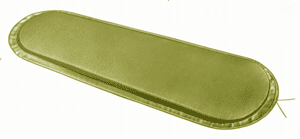
Qualitex is not a trade dress case; however, trade dress is
discussed in resolving arguments by the trademark infringer.
Qualitex sold cleaning pads for dry cleaning establishments. For
many years, its pads were a green-gold color. A competitor began
selling pads of a similar color. Qualitex registered its color as a
trademark and sued for infringement.
The Court held that color alone can be registered as a trademark.
In so holding, the Court noted that anything that distinguishes a
provider can be registered, including a shape (the Coca Cola
bottle), a sound (the NBC chimes), and an odor (a particular
fragrance on sewing thread). The Court saw no reason to preclude
color from distinguishing a product. The Court noted that to be
registered, the color must be distinctive and non-functional. Since
there is nothing inherently distinctive about a color, secondary
meaning is required to develop distinctiveness based on color. If
the color has a function, including an aesthetic function, then it
cannot be registered. The Court gave the example of competitors of
John Deere farm equipment allowed to paint their equipment green
despite John Deere’s trademark because farmers want their equipment
to match. Difficult questions of whether two colors are too similar
or whether the number of colors available is too limited can be
resolved by the courts, which exist to resolve difficult questions.
The infringer argued that trade dress protection under Section
43(a) rendered trademark protection based on color alone
unnecessary. The Court provided a list of topics concerning which
trademark protection is superior to trade dress protection. The
list includes:
a. § 1124 (ability to block importation of confusingly similar
goods).
b. § 1072 (constructive notice of ownership).
c. § 1065 (incontestable status)
d. § 1057(b) (prima facie evidence of validity and ownership
E. Wal-Mart Stores v Samara Bros.,
529 U.S. 205, 120 S.Ct. 1339 (2000)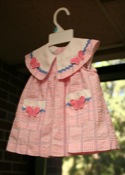
Samara produced a line of children’s clothes
decorated with appliqués and marketed the clothes in the U.S.
through retail department stores. Wal-Mart sent a series of
photographs of Samara products to its overseas supplier with
instructions to produce copies. The supplier did so, and the copies
were sold at Wal-Mart stores. Samara sued Wal-Mart, alleging among
other things infringement of unregistered trade dress under Lanham
Act §43(a). Wal-Mart defended by arguing that the clothing designs
were not distinctive for the purposes of trade dress protection.
The district court and court of appeals found in favor of Samara.
The Supreme Court, in an opinion by Justice Scalia, reversed. The
Court concluded that a product design can be entitled to trade dress
protection; however, like the color in Qualitex, a product design is
not inherently distinctive and can only acquire distinctiveness
through secondary meaning. If a provider wishes to protect a design
prior to the creation of secondary meaning, the provider can obtain
a design patent or copyright. The opinion pulls back from the
expansion of trade dress protection provided by Two Pesos, and
limits that case to its facts. The opinion creates a bright
distinction between product packaging, which can be inherently
distinctive, and product design, which cannot be inherently
distinctive. Said the Court:
To the extent there are close cases, we believe
that courts should err on the side of caution and classify ambiguous
trade dress a product design, thereby requiring secondary meaning.
As a close case, the Court gives the example of the Coca Cola
bottle. The Court notes that the bottle may be product packaging,
which can be inherently distinctive, but also can be part of the
product, for a bottle collector or a person who finds it more
aesthetically pleasing to drink from the specially-shaped bottle.
Coca Cola’s bottle, therefore, would be classified as product under
the Wal-Mart decision and the company would be required to establish
secondary meaning to be entitled to trade dress protection.
F. Traffix Devices v Marketing
Displays, 121 S.Ct 1255 (2001)
Marketing Displays held a patent on a
traffic sign with two springs that would not blow over in the wind.
In the claims, the springs were far apart. During the term of the
patent, a competitor introduced a sign where the springs were close
together. Marketing Displays won a resulting patent infringement
action under the doctrine of equivalents.
Subsequently, Marketing Displays marketed signs with two springs
close together. The patent expired and Traffix introduced a
competing sign. Marketing Displays sued under §43(a) of the Lanham
Act, arguing trade dress protection. Consistent with Wal-Mart,
Marketing Displays argued that the product design with two springs
had acquired secondary meaning and denoted the origin of the signs
to the public.
The district court decided that the two-spring design was
functional and hence could not qualify for trade dress protection.
The court of appeals reversed, holding that “[e]xclusive use of a
feature must ‘put competitors at a significant
non-reputation-related disadvantage’ before trade dress protection
is denied on functionality grounds.” The court of appeals reasoned
that the two springs of the design easily could be covered or
modified, thus any disadvantage to the competitor was not
significant.
The Supreme Court reversed. The Court noted that a product can be
freely copied unless it is protected by law. The existence of the
expired patent creates a strong presumption that the matters
addressed by the patent are functional. The Court stated:
Where the expired patent claimed the feature in
questions, one who seeks to establish trade dress protection must
carry the heavy burden of showing that the feature is not
functional, for instance by showing that it is merely ornamental,
incidental, or arbitrary aspect of the device.
The Court corrected the court of appeal’s
approach to functionality; namely, that a feature was functional
only if denying the feature to competitors placed the competitors at
significant disadvantage. The court of appeal’s position was based
on Qualitex, supra, which discussed the effect of aesthetics on
functionality. The Court in Traffix indicated that the question of
whether competitors were placed at a disadvantage was relevant to
the question of whether a design is aesthetically functional and
hence cannot qualify for trademark or trade dress protection. The
Court further defined functionality in the non-aesthetic context as:
[A] feature is also functional when it is
essential to the use or purpose of the device or when it affects the
cost or quality of the device.